

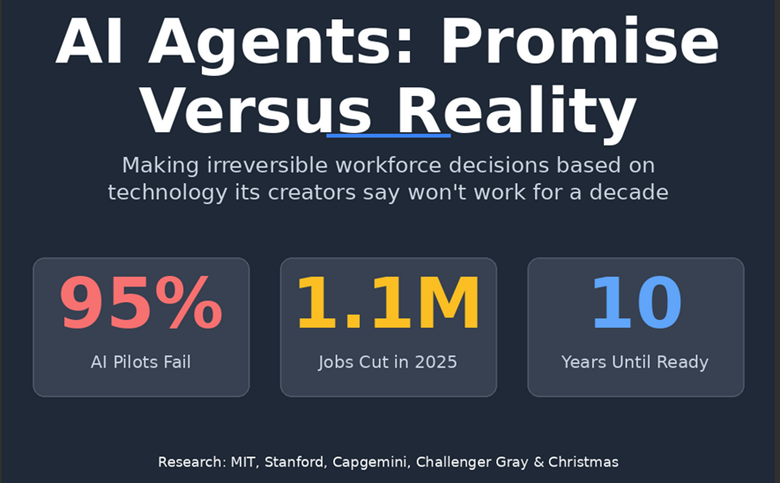
Bottom line: We’re making irreversible workforce decisions based on technology that its own creators say won’t work for another decade.
Andrej Karpathy helped build the AI systems everyone’s betting on. He led AI research at OpenAI. He ran Tesla’s self-driving efforts. When he talks about what these systems can actually do, people should listen.
Last month he said AI agents need another decade before they’ll actually work. Not struggle. Not need improvement. Work at all. “They just don’t work,” he told podcaster Dwarkesh Patel. “They don’t have enough intelligence. They’re cognitively lacking and it’s just not working.”
That same month, companies cut 153,000 jobs. The highest October total in 22 years. Most of those cuts blamed AI adoption. We’re now at 1.1 million job cuts for the year, citing AI as the reason.
Here’s the problem. The person who built this technology says it needs ten more years. The companies deploying it aren’t waiting ten days.
The Numbers Don’t Match The Narrative
I’ve sat through enough board presentations to know the pattern. Someone shows a demo. It looks incredible. Six months later we’re in a different room trying to explain why the results don’t match the deck.
MIT just published research tracking 300 AI deployments. Only 5% achieved measurable revenue acceleration. That means 95% failed. Not underperformed. Failed to deliver any impact on the P&L. Based on 150 executive interviews and analysis of real implementations.
The study found something worse. Companies are pouring over half their AI budgets into sales and marketing tools. The actual ROI? It’s in back-office automation nobody’s prioritizing.
Trust is moving in the wrong direction. Capgemini tracked executive confidence in AI agents. It dropped from 43% to 27% in a single year. We’re using these systems more and trusting them less. That’s not a sustainable trajectory.
We’re Building Solutions Nobody Asked For
Stanford did a full workforce audit. They surveyed 1,500 workers across 104 occupations. The findings should worry everyone making AI investment decisions.
When they mapped Y Combinator company investments to what workers actually want automated, 41% landed in what they call the “low priority” and “red light” zones. We’re building technology for problems workers don’t want solved. Meanwhile, the areas where they’re asking for help remain under-addressed.
The warehousing sector tells the story clearly. Nearly 48,000 job cuts in October alone. A 378% increase from last year. Companies are betting on automation to handle the volume. But the technology Karpathy describes can’t maintain context, can’t learn continuously, and struggles with anything that isn’t pure boilerplate.
The Real Cost Of Moving Too Fast
This isn’t like previous technology transitions. When companies adopted ERP systems or moved to cloud infrastructure, the failure cost was measured in money and time. You could reverse course.
You could rebuild.
Job cuts are permanent. The 1.1 million positions eliminated this year aren’t coming back. When the technology fails to deliver what was promised, those workers won’t be rehired. That’s the bet companies are making.
The gap between promise and delivery shows up everywhere. AI coding assistants work fine for boilerplate tasks that appear frequently in training data. But Karpathy’s own project showed they fail on anything intellectually demanding or unique. The models lack the cognitive depth for complex problem-solving.
Companies are making strategic workforce decisions assuming agent capabilities that don’t exist yet. The technology can’t remember what you tell it. It can’t learn from mistakes. It can’t maintain context across sessions. These aren’t minor limitations. They’re fundamental gaps.
What The Winners Are Doing Differently
Some companies are getting this right. They’re not the ones racing to cut headcount.
They’re running careful pilots with clear metrics. They’re keeping humans involved in critical decisions. They’re measuring ruthlessly before scaling. Most importantly, the layoff announcements come after they’ve proven the technology works, not before.
The MIT study found that purchased solutions from specialized vendors succeed 67% of the time. Internal builds? Success rate drops to 33%. Companies keep trying to build proprietary systems when buying proven tools delivers better results.
The smartest organizations are treating this as augmentation, not replacement. They’re using AI where it’s actually strong—routine data processing, initial draft creation, pattern recognition in structured environments. They’re keeping humans where AI is weak—judgment calls, creative problem-solving, anything requiring real context.
The Questions We Should Be Asking
Here’s what boards should be pressing on. If the technology won’t be ready for a decade according to the people who built it, why are we making permanent workforce decisions now?
When 95% of pilots fail, why do we believe ours will be different? What specific evidence do we have beyond vendor demos?
If trust is declining as usage increases, what does that tell us about real-world performance versus promised capabilities?
The technology will eventually get there. Karpathy’s not pessimistic about the long-term potential. But he’s clear about the timeline. Ten years. Not ten quarters. Not ten months.
Companies that ignore this gap are taking an enormous bet. They’re gambling that their workers’ jobs can wait for technology that doesn’t exist yet. Or they’re gambling that the technology is further along than the people who built it believe.
Both are dangerous assumptions.
Moving Forward Without Moving Recklessly
The path forward requires discipline. Start with the areas where AI actually works today. Back-office automation. Routine data processing. High-volume, low-variability tasks.
Measure everything. Not vendor metrics. Real impact on productivity, quality, and revenue. Set clear success criteria before deployment, not after.
Keep the capability to reverse course. Don’t eliminate institutional knowledge you can’t rebuild. Don’t cut the people who understand how work actually gets done.
Most importantly, stop making irreversible decisions based on reversible pilots. The technology will improve. The question is whether your workforce strategy can survive the decade it takes to get there.
Right now, we’re building a future where the jobs are gone but the technology isn’t ready. That’s not innovation. That’s gambling with people’s livelihoods.
The winners in this transition won’t be the ones who moved fastest. They’ll be the ones who moved smartest. Who kept the human expertise that makes organizations resilient. Who built AI systems that augment capability rather than eliminate it.
Because when Karpathy’s decade arrives and the technology actually works, you’ll need people who still remember how to do the work. The companies that rushed to cut everyone won’t have them.
The choice isn’t whether to adopt AI. It’s whether to adopt it thoughtfully or desperately. Right now, too many are choosing desperate.