

The corporate world is experiencing a seismic shift that makes the early days of the internet look like gentle evolution. Agentic AI — artificial intelligence that can reason, plan, and act independently — isn’t just another technological upgrade. It’s a fundamental reimagining of how work gets done, decisions get made, and value gets created.
While executives debate whether this is hype or reality, the numbers tell a stark story: we’re witnessing the birth of a new economic paradigm that will separate the adaptive from the obsolete.
The Numbers Don’t Lie: A $4.4 Trillion Disruption
The scale of transformation ahead is staggering. McKinsey’s March 2025 report estimates agentic AI could yield $4.4 trillion in productivity growth by automating complex tasks. This isn’t incremental improvement — it’s economic revolution.
Consider the immediate impact already visible across sectors:
Manufacturing: A 2024 study published in Nature Machine Intelligence revealed how integrating agentic AI into industrial robots boosted decision-making efficiency by 35%. These aren’t pre-programmed machines following scripts; they’re adaptive systems that learn, replan, and optimize in real-time.
Healthcare: Ninety percent of hospitals are expected to adopt AI agents by 2025, revolutionizing predictive analytics and patient outcomes. The implications are profound—from diagnostic accuracy to resource allocation, healthcare is becoming proactive rather than reactive.
Retail: Sixty-nine percent of retailers leveraging AI agents report significant revenue growth through personalized shopping experiences. This isn’t about recommendation algorithms; it’s about AI that understands context, anticipates needs, and orchestrates entire customer journeys.
Financial Services: The sector is experiencing complete operational overhaul. By automating repetitive tasks such as data entry, compliance checks, and transaction processing, agentic AI boosts productivity and reduces human error, freeing employees for strategic work.
The Productivity Paradox: Why Traditional Metrix Fall Short
The most striking finding isn’t just the productivity gains—it’s their magnitude. Deloitte reports that businesses using AI have seen a 40% boost in efficiency. But this statistic masks a more complex reality.
MIT research shows generative AI is improving employee productivity by as much as 40%. Yet productivity gains from agentic AI dwarf these numbers because they represent a qualitative shift, not just quantitative improvement.
Traditional productivity metrics measure output per hour. Agentic AI breaks this model entirely. When an AI agent can simultaneously manage multiple complex workflows, learn from each interaction to improve future performance, operate 24/7 without fatigue or human oversight, and adapt to new situations without explicit programming, the concept of “productivity” becomes inadequate. We’re not just doing more work faster; we’re doing different work entirely.
The Great Divide: Winners And Losers In The Agentic Economy
The deployment of agentic AI is creating a stark bifurcation in the business world. One in three companies is already investing in agentic AI by 2024, and those modernizing processes with AI are seeing 2.5× higher revenue growth and 2.4× greater productivity than peers.
This isn’t just temporary competitive advantage — it’s a fundamental restructuring of competitive dynamics. Companies that successfully integrate agentic AI are operating in a different economic reality than their competitors.
The Winners: Early adopters are experiencing compound advantages. Sixty-two percent of companies anticipate a full 100% or greater return on investment from their AI agent deployments. These aren’t hopeful projections; they’re based on measurable outcomes from pilot programs and early deployments.
The Laggards: The other side of this equation is sobering. Companies that delay adoption aren’t just missing opportunities—they’re facing structural disadvantages that compound over time.
The Reality Check: Why Half Will Fail
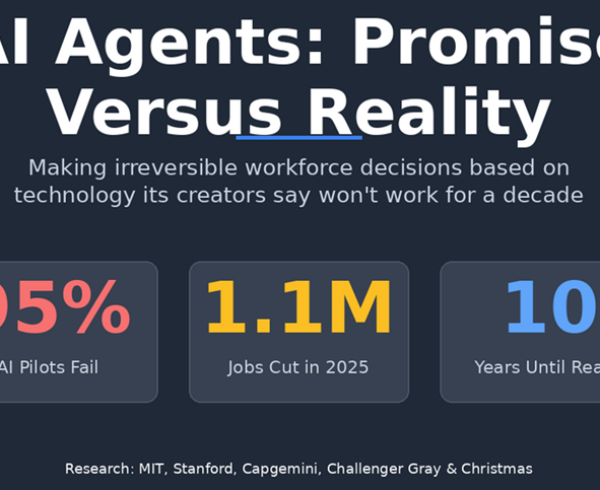
Despite the revolutionary potential, a harsh reality check looms. Over 40% of agentic AI projects will be canceled by the end of 2027, due to escalating costs, unclear business value, or inadequate risk controls, according to Gartner.
This prediction isn’t pessimistic — it’s realistic. Agentic AI isn’t plug-and-play technology. It requires fundamental rethinking of business processes, new governance frameworks, cultural adaptation to human-AI collaboration, and substantial upfront investment in infrastructure and training.
The companies that succeed won’t be those with the biggest budgets or the most sophisticated technology. They’ll be those that understand agentic AI as business transformation, not technical implementation.
Industry-Specific Disruption Patterns
Manufacturing: The Autonomous Factory Floor
Manufacturing is experiencing the most dramatic transformation. On average, AI saves 62 minutes per day in manufacturing through applications in predictive maintenance, quality control, and supply chain optimization. But this statistic understates the revolution.
Agentic AI in manufacturing isn’t just about efficiency — it’s about adaptability. Traditional manufacturing optimizes for consistent, predictable processes. Agentic AI enables dynamic optimization based on real-time conditions, demand fluctuations, and supply chain disruptions.
Healthcare: From Reactive To Predictive
Healthcare’s adoption of agentic AI represents more than operational efficiency — it’s a paradigm shift from reactive treatment to predictive intervention. AI agents can simultaneously monitor thousands of patients, identify early warning signs, and coordinate care across multiple providers.
Financial Services: The Intelligent Money Manager
Financial services is being fundamentally restructured. Agentic AI doesn’t just process transactions — it understands context, assesses risk, and makes decisions that previously required human judgment. The result is financial services that are more personalized, more efficient, and more accessible.
The Human Factor: Collaboration, Not Replacement
The most successful agentic AI implementations don’t replace human workers — they augment them. With their supercharged reasoning and execution capabilities, agentic AI systems promise to transform many aspects of human-machine collaboration.
This collaboration model is creating new categories of work: AI Orchestrators who design, deploy, and manage AI agent networks; Human-AI Interpreters who translate between human intentions and AI capabilities; and Strategic Supervisors who focus on high-level decision-making while AI handles tactical execution.
The Investment Imperative: Why Waiting Isn’t An Option
The window for strategic advantage is rapidly closing. Almost all companies invest in AI, but just 1% believe they are at maturity. This gap between investment and maturity represents both opportunity and risk.
For businesses evaluating agentic AI, the question isn’t whether to adopt—it’s how quickly they can transform their operations to leverage autonomous intelligence effectively.
The companies that will dominate the next decade aren’t those with the best current products or services. They’re those building the most sophisticated human-AI collaboration systems.
The Future Is Autonomous
Agentic AI isn’t just another technology trend—it’s the foundation of a new economic model. The Decision Intelligence Market is projected to reach $50.1 billion by 2030. This growth represents more than market opportunity; it represents economic transformation.
The businesses that understand this transformation and adapt accordingly will thrive. Those that treat agentic AI as a tool rather than a paradigm shift will find themselves competing in yesterday’s economy while their rivals operate in tomorrow’s.
The agentic AI revolution isn’t coming — it’s here. The only question is whether your organization will lead it, follow it, or be left behind by it.
The convergence of autonomous intelligence with human creativity and strategic thinking represents the most significant business transformation since the industrial revolution. Organizations that embrace this convergence will define the next era of commerce, innovation, and value creation.