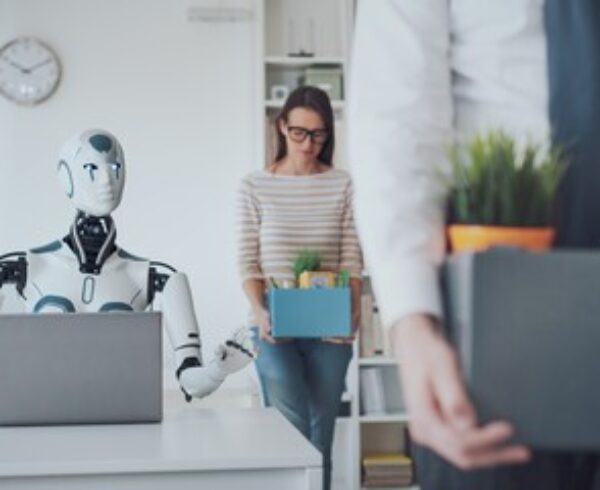

Ford, Commonwealth Bank of Australia, and IBM have one thing in common as of mid-2026. Each cut jobs for AI. Each has since brought people back.
CNBC reported the pattern directly in July 2026: three companies, three industries, the same discovery made independently. The technology could not fully replace the roles they had eliminated.
This is no longer a single company's embarrassing correction. It is a documented, ongoing pattern, still unfolding as this goes to print, and the shape of it is remarkably consistent across every company willing to admit it happened.
Three Companies, One Discovery
Commonwealth Bank of Australia cut forty-five customer service jobs for a voice bot in 2025. Within three weeks, call volumes hadn't dropped the way projected. They'd risen. Team leaders were pulled onto phones. The bank reversed the decision and admitted its assessment "did not adequately consider all relevant business considerations."
Ford spent the years since discovering the same gap in a completely different function. Automated quality-control systems couldn't replicate the judgment of veteran engineers, and without that judgment, the tools amplified weak inputs instead of catching them. Ford's vice president of vehicle hardware engineering, Charles Poon, put it plainly: the company had wrongly assumed that feeding AI its design requirements would produce a high-quality product without experienced human oversight. Ford brought back three hundred fifty veteran engineers. In 2026, the company topped
J.D. Power's Initial Quality Study rankings for the first time since 2010.
IBM's version showed up in human resources. An AI system handled roughly ninety-four percent of incoming requests successfully. The remaining six percent, the cases involving ethical judgment and situations no procedure fully covered, exposed exactly where full automation ran out of road. IBM announced plans to triple its US entry-level hiring in 2026. Its chief human resources officer, Nickle
LaMoreaux, named the actual stakes: without continued investment in entry-level hires, the pipeline dries up in three to five years, and there's no way to rebuild the judgment lost once it's gone.
Why This Keeps Happening To Careful Companies
None of these were reckless companies. Ford, CBA, and IBM are not startups moving fast and breaking things. They are large, established organizations with real planning processes, and each one still made the same category of mistake: pricing the visible, structured part of a job accurately, and pricing the judgment underneath it at zero.
That judgment doesn't show up in the metrics most companies already track. It shows up only when it's missing, in the calls that don't resolve, the defects that don't get caught, the six percent of cases nobody wrote a procedure for. By the time the gap is visible in the numbers everyone was already watching, the layoff has already been announced, and the reversal, when it comes, comes publicly.
This is not a story about AI failing to work. Ford's quality-control tools function. IBM's HR system handles the overwhelming majority of its caseload correctly. Commonwealth Bank's voice bot answers real calls. The failure sits specifically in the six percent, the edge cases, the moments a script doesn't cover, which is exactly where the judgment nobody measured was doing more of the actual work than anyone realized.
Deloitte's own research explains why this keeps catching careful companies off guard rather than just careless ones. Eighty-five percent of leaders say adaptable judgment is the key competitive strategy for the next few years. Only seven percent are confident they've actually built the capability to develop it inside their own workforce. That gap between stated value and built capability is exactly the gap that let three separate companies' initial assessments through without anyone catching the error in time. Leaders were not wrong about what mattered. They had simply never measured it well enough to notice they were about to cut it.
Peter Wheeler, who leads PwC Australia's workforce and change advisory practice, described the shift in plain terms: the workforce ahead requires more judgment and critical thought as AI adoption increases, not less. Ford, CBA, and IBM didn't need that forecast to prove itself in a five-year labor market projection. Each one proved it in-house, inside a single fiscal year, at a cost specific enough to require a public correction.
What The Pattern Says About The Next Round Of Cuts
If this were one company's mistake, it would be a cautionary anecdote. Three companies, in three different functions, independently discovering the identical gap and reversing course within the same year, 2026, is something closer to a market correction than an anecdote. The question worth asking is not whether this pattern will continue. It's how many more companies will discover it the expensive way, publicly, after the layoff rather than before it.
The fix is not caution about automation generally. It's a specific question a board can ask before the next role gets eliminated: what share of this job is the visible, structured task, and what share is the judgment nobody wrote down because a person doing it made writing it down unnecessary. Ford, CBA, and IBM each answered that question backward, cutting first and discovering the answer afterward, in public, at a cost specific enough to reverse.
Answering that question honestly before the cut, rather than after it, requires talking directly to the people currently doing the job, not just measuring the outputs the job produces. A call-volume dashboard or a defect-tracking system will tell a company how much work got done and how fast. It will not tell that company which fraction of that output only came out clean because someone recognized an edge case the system was never built to catch, and improvised a solution that happened to work. That recognition is invisible in every dataset a company already owns, which is precisely why it gets valued at zero by default, right up until the moment it's gone and the calls start piling up.
The organizations that avoid repeating this pattern won't be the ones moving slower on AI. They'll be the ones that priced the invisible part of the job before eliminating the visible part, rather than waiting to find out the price the way Ford, CBA, and IBM already have.
References
Cabili, Colleen. "Companies Rehire Workers Laid Off for AI as Automation Falls Short." Quartz, qz.com, July 1/3, 2026, citing CNBC.
Bloomberg. "Australia's Biggest Bank Reverses Plan to Replace Jobs With AI." bloomberg.com, August 21, 2025.
HCAMag. "CBA Reverses AI-Triggered Employee Layoffs." hcamag.com, August 2025.
Deloitte. "2026 Global Human Capital Trends: From Tensions to Tipping Points." deloitte.com, 2026.
PwC. "2026 AI Jobs Barometer." pwc.com.au, 2026.