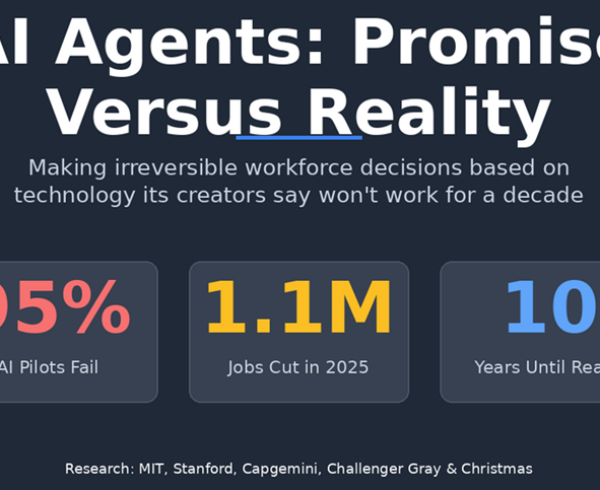


70% of AI initiatives fail — not because of technology, but because organizations approach them with the wrong mindset entirely.
The boardroom conversation is always the same. “We need an AI strategy.” “What’s our AI roadmap?” “How do we govern this?” Yet while executives debate frameworks and governance structures, their competitors are quietly building AI capabilities that will fundamentally reshape entire industries. The organizations asking the wrong questions will find themselves automated out of relevance by those who understood what questions to ask.
The harsh truth is that AI adoption failure is not a technology problem — it is a leadership problem. The companies struggling with AI implementation are the same ones that excel at traditional strategic planning, risk management, and operational excellence. Their very strengths in conventional business management become liabilities in AI adoption. Understanding these barriers and how to overcome them separates organizations that transform from those that merely talk about transformation.
Barrier 1: The Planning Paralysis Trap
The most dangerous barrier is treating AI adoption like a traditional IT implementation. Organizations spend months developing comprehensive AI strategies, conducting readiness assessments, and creating detailed governance frameworks before deploying a single AI application. This approach worked brilliantly for ERP systems and infrastructure projects, but it is systematically counterproductive for AI adoption.
The Problem: AI technology evolves faster than planning cycles. By the time most organizations complete their AI strategy documents, the underlying technology assumptions have become obsolete. Meanwhile, market conditions shift, rendering carefully crafted implementation roadmaps irrelevant before execution begins.
The Solution: Replace planning with rapid experimentation cycles. Amazon exemplifies this approach — rather than commissioning extensive feasibility studies before entering new AI markets, they design minimal viable tests that validate core assumptions within weeks, not months. Establish 90-day experimentation cycles where teams propose AI applications, receive small
budgets to test hypotheses, and present results to leadership for scaling decisions.
Barrier 2: The Data Perfectionism Syndrome
The second major barrier is waiting for perfect data infrastructure before beginning AI initiatives. Organizations convince themselves they need comprehensive data lakes, perfect data quality, and complete integration across all systems before deploying any AI applications. This perfectionist approach creates indefinite delays while competitors build AI capabilities with imperfect but available data.
The Problem: Perfect data preparation becomes an excuse for permanent inaction. Organizations spend enormous resources on data infrastructure projects that may never reach completion, while immediate AI value opportunities remain unexplored. The pursuit of perfect data often costs more than the AI applications it enables.
The Solution: Start with available data and improve infrastructure iteratively. Netflix transformed entertainment by building recommendation algorithms with incomplete viewing data, then improving data collection based on what their AI systems actually needed. Identify AI applications that can generate value with currently available data, deploy these applications quickly, and use the insights gained to guide infrastructure investments.
Barrier 3: The Cultural Resistance Reality
The third barrier is organizational cultures optimized for predictability and control rather than experimentation and adaptation. Most organizations have spent decades rewarding careful analysis, risk mitigation, and execution precision. These cultural characteristics enabled success in stable environments but become liabilities in AI adoption, where uncertainty, experimentation, and intelligent risk-taking determine success.
The Problem: Traditional organizational cultures punish the experimental mindset required for successful AI adoption. Employees avoid AI initiatives that might fail, preferring safe but non-transformative projects. Leaders demand detailed ROI projections for AI experiments that are inherently uncertain, creating analysis paralysis around opportunities that require rapid testing to validate.
The Solution: Create dual reward systems that celebrate both operational excellence and intelligent experimentation. Google’s famous “20% time” policy enabled employees to experiment with innovative projects without career risk, leading to breakthrough products like Gmail and Google News. Establish separate evaluation criteria for experimental AI initiatives versus operational projects, and create “failure celebrations” where teams share insights from unsuccessful experiments.
Barrier 4: The Skills Gap Illusion
The fourth barrier is the widespread belief that AI adoption requires hiring armies of data scientists before beginning implementation. Organizations delay AI initiatives while searching for rare talent with perfect credentials, missing immediate opportunities to build AI capabilities with existing teams enhanced by targeted external expertise.
The Problem: The “hire first, implement later” approach creates expensive delays while AI talent costs continue rising. Organizations often hire AI specialists without clear deployment plans, leading to expensive talent sitting idle while business teams continue operating without AI augmentation.
The Solution: Build AI capabilities through partnerships and existing team augmentation rather than talent acquisition alone. Tesla accelerated their autonomous driving development by combining internal automotive expertise with targeted AI partnerships, rather than trying to hire every AI capability in-house. Partner with AI platforms for initial implementations while training internal teams on AI applications relevant to their domains. Focus on building “AI fluency” across business teams rather than “AI expertise” concentrated in specialized roles.
Barrier 5: The ROI Measurement Mismatch
The fifth barrier is applying traditional ROI measurement frameworks to AI initiatives that generate value through discovery and capability building rather than immediate operational returns. Organizations demand precise financial projections for AI experiments that are inherently exploratory, missing transformative opportunities that do not fit conventional business cases.
The Problem: Traditional ROI frameworks measure efficiency gains from known processes rather than value creation from new capabilities. AI initiatives often generate their greatest value through discoveries that were not anticipated in original business cases, making conventional financial justification inadequate for AI investment decisions.
The Solution: Develop portfolio approaches to AI investment that balance immediate return initiatives with exploratory capability building. Microsoft’s approach combines revenue-generating applications like Office 365 AI features with research investments in frontier capabilities, creating both immediate value and long-term competitive advantages. Allocate AI budgets across three categories: quick wins with immediate ROI, capability-building initiatives with medium-term value potential, and exploratory research with uncertain but potentially transformative outcomes.
The Integrated Solution: Building AI-Native Organizations
Overcoming these barriers requires more than tactical fixes — it demands fundamental changes in how organizations operate. The most successful AI adopters have developed integrated approaches that address all five barriers simultaneously through what we call “AI-native operating models.”
Continuous Experimentation Cycles: Replace annual strategic planning with quarterly experimentation cycles that identify AI opportunities, test applications rapidly, and scale successful approaches. This creates organizational rhythm around discovery rather than planning.
Iterative Infrastructure Development: Build data and technology infrastructure based on actual AI application needs rather than theoretical requirements. This ensures infrastructure investments generate immediate value while supporting future capabilities.
Experimental Culture Systems: Maintain operational excellence for core business processes while creating experimental freedom for AI initiatives. This preserves organizational stability while enabling transformative innovation.
Distributed AI Fluency: Build AI understanding across business teams rather than concentrating expertise in specialized roles. This creates scalable AI capability that grows with organizational needs.
Portfolio Value Assessment: Evaluate AI initiatives across immediate returns, capability development, and exploratory research rather than applying uniform ROI criteria. This enables balanced investment across different value creation timeframes.
The Competitive Imperative
The window for competitive AI adoption is closing rapidly as early movers establish advantages that become increasingly difficult to overcome. Organizations that continue applying traditional management approaches to AI adoption face systematic disadvantage against competitors who have developed AI-native operating models. The performance gap widens over time as adaptive organizations accumulate AI capabilities while traditional competitors remain constrained by conventional frameworks.
The choice confronting every executive is not whether to adopt AI, but whether to overcome the barriers that prevent effective AI adoption. The organizations that master these challenges will not merely implement AI tools — they will develop AI-native thinking that enables continuous innovation as technology evolves. Those that persist with traditional approaches will provide case studies in how operational excellence cannot compensate for strategic obsolescence.
The transformation starts with recognizing that AI adoption success depends not on having better plans but on building better capabilities for rapid experimentation, iterative development, and continuous discovery. The organizations that act first to overcome these barriers will write the competitive rules that others must follow.